How We Prepare Websites for AI Search Visibility
Written by Gabriel Bertolo
April 14, 2026
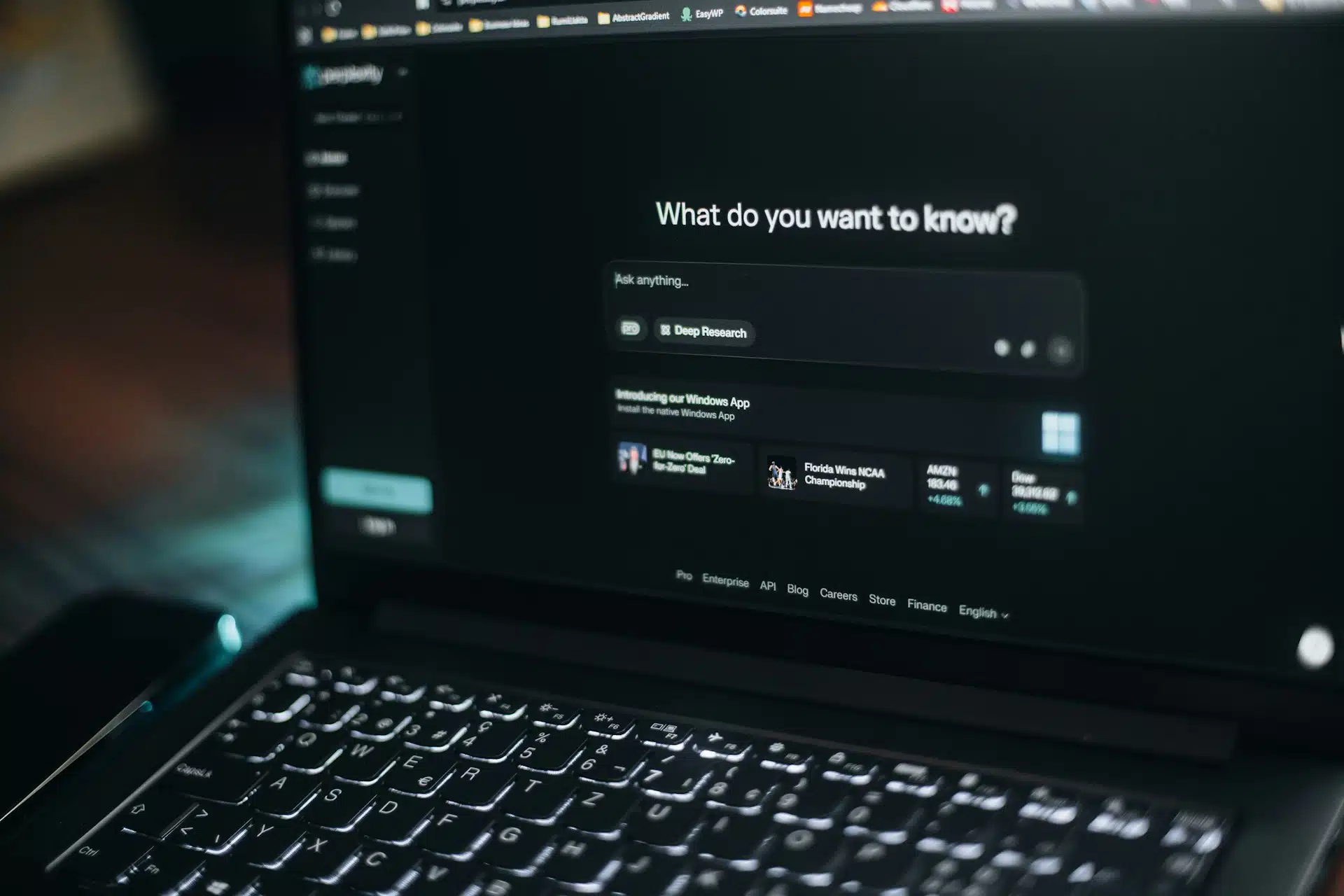
I had a client call me last month, frustrated because their Google Ads cost per lead had gone up 40% in six months. Same budget, same targeting, fewer leads. We dug into it, and the traffic numbers from organic search told a different story than what they expected. Their impressions were steady, but clicks were falling off a cliff. Not because they lost rankings. Because Google was answering the query directly in an AI Overview at the top of the page, and nobody was scrolling past it.
That’s what we’re dealing with now. The search landscape didn’t evolve gradually. It fractured.
People are asking ChatGPT, Perplexity, Google AI Overviews, Claude, and Gemini for direct answers instead of clicking through 10 blue links. These AI search engines don’t list your website. They pull information from sources they trust, synthesize it into a single response, and cite whoever they consider most authoritative. If your business isn’t one of those cited sources, the user never sees you. They don’t even know you exist.
Gartner predicts that traditional search engine volume will drop 25% by 2026, with search marketing losing market share to AI chatbots and other virtual agents. Source – Gartner
This is Gartner, not some SEO blog speculation. And the shift is already measurable.
AI-referred sessions jumped 527% between January and May 2025. Source – Frase
That’s where Generative Engine Optimization comes in. GEO is the practice of optimizing your website and content so AI search engines cite you as a trusted source. Think of it as a new layer on top of traditional SEO. It doesn’t replace what’s already working. But if you’re only doing traditional SEO in 2026, you’re optimizing for half the picture.
At Radiant Elephant, we’ve been studying and implementing AI search optimization since the earliest research dropped. We’ve already produced results with it. A B2B manufacturer we work with achieved the #1 position in Google AI Overview ahead of FDA.gov and two Fortune 100 competitors. That’s a real result on a real client, not theory.
I’m going to break down exactly how we prepare websites for AI search visibility. If you want to do this yourself, this gives you the playbook. If you want to hire someone, at least you’ll know what to look for and what questions to ask.
Let me explain what’s actually happening in simple terms.
When someone asks Google a question in 2026, there’s a solid chance the top of the results page shows an AI Overview. It’s a generated answer that pulls from several sources and gives the user what they need without them ever clicking on a website. Same thing with ChatGPT Search, Perplexity, and Claude. The user gets their answer and moves on.
I’ve watched this happen in real time with client analytics. Pages that ranked #2 or #3 for years, generating steady traffic, suddenly showed the same impressions but a fraction of the clicks. The ranking didn’t change. The behavior did. People stopped clicking because the AI gave them the answer first.
89% of B2B buyers have adopted generative AI as a key source of self-guided information throughout their purchasing journey. Source – Profound
And here’s where it gets really competitive. In traditional Google search, you have 10 organic spots on page 1. In AI-generated responses, the LLM typically cites only 2-7 sources. That’s it. Getting into those few citation slots is the new version of ranking #1. And unlike traditional SEO, where rankings fluctuate constantly, once an LLM identifies a trusted source, it tends to reinforce that choice across related queries. Which means the longer you wait, the harder it gets.
Traditional SEO is about ranking for keywords and earning clicks. GEO is about becoming the source that AI trusts enough to extract information from and cite. The AI doesn’t rank your page. It reads it, evaluates it, and decides whether your content is credible enough to reference. The ranking factors are different, too. Citation authority, content structure, semantic clarity, E-E-A-T signals, entity relationships, and what third parties say about you across the web.
Traditional SEO still matters. It’s the foundation. If Google can’t find and understand your website through traditional SEO, AI search engines can’t either. But doing traditional SEO alone is like having a great storefront on a street where foot traffic is declining. You also need to be where the new traffic is going.
Large language models don’t read your website the way a human does. They tokenize your HTML, analyze semantic structure, and extract specific answers to specific questions. If your content isn’t structured clearly, the AI skips you and cites a competitor whose content is easier to parse.
I learned this firsthand working on the B2B manufacturing client. We tested different content structures on similar pages within the same site. Pages with question-format headings and direct answers in the first 40-60 words consistently got cited. Pages with vague headings and buried answers didn’t. Same domain authority. Same topic. The structure made the difference.
Instead of a heading like “Our Services,” you use “What Commercial Cleaning Services Do We Offer in Northampton?” That second heading maps directly to how someone would ask ChatGPT or Perplexity the same question. Then you put a direct, concise answer right after it. AI engines frequently extract that introductory text as the citation. If the answer is buried in paragraph three, you’re far less likely to be selected.
FAQ sections are one of the most powerful tools for AI visibility right now. 5-10 questions formatted as H3 headings that mirror the exact questions your customers ask, each with a thorough but concise answer. These map directly to conversational queries, which is exactly how people interact with AI search. I’ve been implementing these on every client site, and the correlation between well-structured FAQ content and AI citations is hard to ignore.
A study by researchers at Princeton University, Georgia Tech, and the Allen Institute for AI tested nine different optimization methods across 10,000 queries and validated on real generative engines, including Perplexity.
GEO techniques, including citations, statistics, and quotations, can boost content visibility in AI-generated responses by up to 40%. Source – Princeton University
That’s a peer-reviewed finding, not a marketing claim.
This is the core of what separates content that AI cites from content it ignores. And it’s not what most people expect.
The Princeton study identified three specific techniques that consistently outperformed everything else: citing credible sources, adding statistics, and including expert quotations. These three methods delivered 30-40% visibility improvements across all content categories tested. Not one of them is fancy or technically difficult. They just require discipline and a commitment to writing content that’s actually useful.
Citing credible sources means referencing .edu sites, .gov data, industry research, and published studies. When your content demonstrates research rigor, AI engines treat it as more trustworthy. I’ve been building this into every article I write for Radiant Elephant for the past year. Every claim is backed by a source. Every statistic is linked. It’s more work, but the difference in how AI engines treat the content is measurable.
Statistics replace vague claims. “We significantly improved our client’s traffic” means nothing to an AI engine. “We increased organic traffic by 45.2% in 90 days” is specific, verifiable, and extractable. I aim for a relevant statistic roughly every 150-200 words. Not random numbers crammed in, but data that actually supports the point being made.
Expert quotations give AI another extraction point. AI responses frequently pull direct quotes when constructing answers. Real quotes from recognized professionals in your field add a layer of authenticity that AI engines reward.
And here’s something a lot of SEOs miss. The Princeton study found that keyword stuffing actually DECREASED visibility by 10%. The old-school tactic of jamming keywords into every sentence actively hurts you in AI search. If your SEO strategy is still built on keyword density, it’s working against you.
A practical guideline I use: a 3,000-word article should contain 15-20 statistics with proper source attribution. Think of it as fact density. AI engines assess the ratio of verifiable claims to general statements. Higher density, higher citation probability.
Here’s a quick before and after to illustrate.
Before: “Page speed is important for conversions. Slow websites lose customers.”
After: “According to Google research, for every one-second delay in mobile page load, conversions can drop by up to 20% (Source – Google). Sites loading in 1 second convert at 3x the rate of sites loading in 5 seconds.”
The second version is specific, sourced, and something an AI can extract and cite. The first version is filler.
Lower-ranked websites saw up to 115% increase in AI visibility using GEO techniques, potentially outperforming larger corporate sites. Source – Search Engine Journal
That finding matters a lot if you’re a small or mid-sized business. You don’t need massive domain authority to get cited. You need content that AI engines trust. That’s a genuinely different dynamic than traditional SEO, where the big players with thousands of backlinks have dominated for years.
Schema markup is something I implement on every client site, and most business owners have never heard of it. It’s a standardized code vocabulary that explicitly tells search engines and AI what your content means. Without it, AI engines have to guess what your page is about based on raw HTML. With it, you’re telling them directly: this is our business, this is what we do, these are our services, here are our reviews, these are the experts on our team.
I got deep into advanced schema implementation on the Boston therapy practice SEO project, where we wrote an entity-rich Person Schema for each therapist, including credentials, specializations, and professional affiliations. That schema was a key factor in the recovery from their algorithm penalty. Google finally had clear signals that real, qualified experts were behind the content.
The schema types I implement for most businesses are Organization (business identity and entity relationships), LocalBusiness (local visibility), Article and BlogPosting (content), FAQPage (question-answer content, critical for AI visibility), and Review (social proof signals). All in JSON-LD, which is Google’s preferred format. It sits in your page code without affecting anything visible.
LLMs grounded in knowledge graphs achieve 300% higher accuracy compared to those relying solely on unstructured data. Source – Schema App
Structured data is how your business contributes to those knowledge graphs. The more clearly you define your entities, relationships, and context through schema, the easier AI engines to understand and cite you accurately.
Pages with structured data receive up to 40% higher click-through rates than standard search results. Source – Future Digital
And schema isn’t just about AI search. Rich results, the enhanced search listings with star ratings, FAQ dropdowns, and other visual elements, earn significantly more clicks in traditional search, too. It’s a dual benefit. And only about 30% of websites currently use it. So if you implement it properly, you have an immediate competitive advantage.
At Radiant Elephant, I handle all the technical schema work. The client doesn’t need to understand a line of code.
This is the part most businesses miss when they think about AI search visibility. And honestly, I think it might be the most important part.
AI search engines trust what OTHERS say about your brand more than what YOU say about yourself. Research from arXiv analyzing AI search behavior found an overwhelming bias toward earned media, meaning third-party authoritative sources, over brand-owned content.
Your own website matters. But the ecosystem around your brand is what really determines whether AI cites you.
I think about it in three buckets.
Third-party mentions. Reviews on Google, Yelp, and industry directories. Platform profiles like Trustpilot and industry-specific review sites. NAP consistency (Name, Address, Phone) across all listings. AI cross-references signals from multiple sources, and inconsistencies create doubt. If your business name is spelled differently across three directories, that’s a problem.
Earned media. Guest articles in industry publications, local press coverage, podcast appearances, and interviews. I’ve been doing this for Radiant Elephant over the past year, and the correlation between third-party mentions and AI citations is clear. Every earned mention is another data point telling the AI: this source is legitimate, and other credible sources vouch for it.
Community presence. This one surprised me. Reddit, LinkedIn, YouTube, and Quora are among the most frequently cited sources by LLMs. Not because they’re prestigious, but because they contain detailed, conversational, expert-level answers to specific questions. When your brand creates substantive content on these platforms, not promotional posts, but actually helpful contributions, you give AI engines more material to work with.
More than 71% of Americans already use AI search to research purchases or evaluate brands.
When 71% of your potential customers are using AI to evaluate their options, your digital footprint across the web isn’t optional. At Radiant Elephant, we don’t just build your website. We build the entire digital ecosystem so AI engines have a clear, consistent, authoritative picture of your brand from every angle.
AI search optimization isn’t something you set up once and walk away from. AI platforms update constantly, citation patterns shift, and competitors are starting to catch on. What gets cited today might not get cited in 3 months if someone publishes something better structured or more current.
I track several things for clients. AI bot traffic is the first one. GPTBot (ChatGPT), GoogleBot (AI Overviews), PerplexityBot, ClaudeBot. Understanding which bots are crawling your content, how often, and which pages they’re accessing tells you a lot about where you stand. Brand mention frequency in AI-generated responses is another. Is the frequency going up or down? How do you compare to competitors?
Content freshness matters more in AI search than I initially expected. AI engines clearly favor recently updated content. We build a regular update cadence for clients, refreshing statistics, adding new data, and updating examples. It’s not glamorous work, but it maintains citation eligibility.
I maintain two separate performance views for clients: one for traditional SEO (rankings, organic traffic, keyword positions) and one for AI visibility (citation frequency, mention sentiment, AI-referred sessions). You need both dashboards to see the full picture. A lot of agencies aren’t even measuring the second one yet.
There’s also a technical consideration around robots.txt. You can allow or block specific AI crawlers from accessing your content. There are strategic reasons to allow them and strategic reasons to be selective. I evaluate this on a case-by-case basis depending on the client’s goals and competitive situation.
We were one of the first agencies in Western Massachusetts to offer dedicated Generative Engine Optimization services. Not because it was a trendy thing to add to the services page. Because I saw the research from Princeton and the Gartner predictions, and recognized that this shift was going to fundamentally change how businesses get discovered online.
I’ve been doing SEO for over 13 years. I’ve watched this industry go through a dozen major shifts. Penguin. Panda. Helpful Content Updates. Core Web Vitals. Mobile-first indexing. Every time, the agencies that adapted early came out ahead, and the ones that said “let’s wait and see” spent the next two years trying to catch up.
GEO feels like the biggest shift since mobile-first indexing, maybe bigger. And the window for early adoption is still open, but I can see it closing. More agencies are starting to talk about it. More competitors are starting to pay attention.
The B2B manufacturing case study is a good example of what early adoption looks like. A DR 21 domain outranking FDA.gov and Fortune 100 competitors in AI search. That’s not supposed to happen in traditional SEO. But in AI search, citation authority and content quality can override raw domain authority. That advantage exists right now because most competitors aren’t optimizing for this yet.
Because Radiant Elephant is owner-led, you get direct access to the person who writes the schema, analyzes the data, and builds the strategy. Not filtered through an account manager. Not handled by a junior team member. We serve growth-ready businesses in Western Massachusetts, Boston, and New Jersey.
Here’s my honest read on the situation. AI search isn’t going to replace traditional search entirely. But it’s going to keep taking a larger share of how people find information and make buying decisions. The businesses that build AI visibility now are establishing citation patterns that reinforce over time. Once an LLM identifies you as a trusted source for a topic, it tends to keep citing you for related queries. That’s a real strategic advantage.
The businesses that wait are going to find themselves trying to break into citation slots that are already occupied by competitors who moved earlier.
Structure your content so AI engines can easily extract and cite it. Build authority signals through sourced statistics and expert content. Implement schema markup so machines understand your brand. Strengthen your presence across the web through earned media and third-party signals. And monitor the results so you can adapt as the landscape keeps evolving.
Your customers are using AI search. The only question is whether they’re finding you when they do.
If you want to see where your website currently stands, schedule a free AI visibility assessment with Radiant Elephant. I’ll run the analysis and give you an honest look at where you are and what needs to change.

Gabriel Bertolo is a 3rd generation entrepreneur who founded Radiant Elephant over 13 years ago after working for various advertising and marketing agencies.
He is also an award-winning Jazz/Funk drummer and composer, as well as a visual artist.
His Web Design, SEO, and Marketing insights have been quoted in Forbes, Business Insider, Hubspot, Entrepreneur, Shopify, MECLABS, and more.
Check out some publications he's been quoted in:
Quoted in HubSpot's AI Search Visibility Article and HubSpot's Article on 6 Best Wix Alternatives
Quoted in DesignRush Dental Marketing Guide
Quoted in MECLABS
Quoted in DataBox Website Optimization Article and DataBox Best SEO Blogs
Quoted in Seoptimer
Quoted in Shopify Blog